Over the past few years it's become a widely-held principle that the internet-related art communities of New York and Berlin commingle with each other far more fluently and regularly than either do with that of London. Why, you may ask? Though the answer remains to seen, one could gather that the cost of living in London far surpasses that of Berlin or the more affordable boroughs of New York City, which are clearly more friendly to artists who make no money from their work; or that importantly, the American social networking platforms acting as a catalyst to internet related art communities only recently gained traction in London, though they've been long popular with New Yorkers and ex-pat Berliners. Regardless of these conjectures, this perceived lack of communication with Londoners in such a globalized phenomenon was enough of an impetus to pull me down from a vacation in Glasgow to scope out the city's scene.
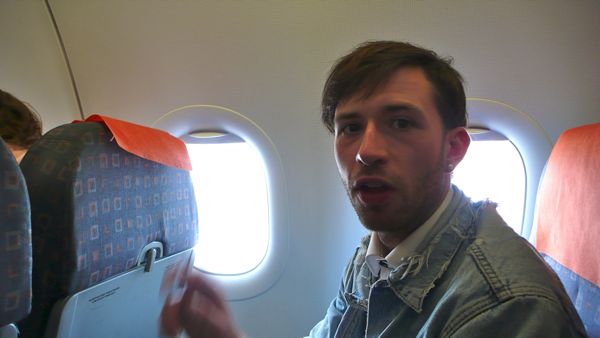
Greeting me upon my arrival was the venerable Ben Vickers, a colleague and friend I met on my last trip to London, at his warehouse in Manor House, perhaps the Bushwick equivalent of North London. I'd been in touch with Vickers since he curated an exhibition with some internet art “usual suspects” for a gallery in Peckham—Jon Rafman, Parker Ito, etc. —which, at the time, seemed an anomalous locale for these buzz names. Although I've written previously about Vickers' work with the now-defunct duo Sopping Granite, it feels strange to write about him now. Not only has he become more of a friend than a professional contact, but I wonder how much he would even care that I write about him, or how useful it would be to him, or if he would consider this as a flag in the journey of his burgeoning practice, as most artists likely would. This is all indicative of Vickers' “practice,” if you could call it that. For a moment I wondered if he was even still “making art,” via the web-based photoshop collages or performances that I'd become familiar with. It was only after a week into my trip to London I realized that his daily behavior—which generally consists of “social engineering,” as he likes to call it, or IRL social networking mimicking and displacing the functionality of Facebook, suggesting two people should formally meet because of convergent interests, almost like a political and net art Yente—is a practice in itself. While Vickers prefers to work through the construction of conditions rather than the creation of images or objects when viewed through a contemporary art context this can be seen through the lineage of critical art practice, otherwise, it could be seen as a sort of political activism. Although Ben is certainly an indispensable peer to his friends and colleagues for this reason, he claims to have an “uninstrumental” approach to art world, perhaps working similarly to a behind-the-scenes administrator or a critical, non-commercial artist who could never get over the icky feeling of participating in the international contemporary art world's luxury economy.

Corin Sworn, Still from Endless Renovation (2010.)
The evening of my arrival I buzzed out of Manor House to the Tate Summer Party to celebrate Canadian-born, Glasgow-based artist Corin Sworn and her inclusion in the Tate Modern's collection. Installed in the depths of the museum is her project “Endless Renovations” (2010), which comprises a slide projector perched upon mirrored commercial shelving, a spot-lit floral bouquet, and curtains cordoning off the space. Admittedly, I approach any artistic project utilizing obsolete technology with the greatest skepticism because it always seems to beget retro-aesthetic posturing (“doesn't this polaroid portrait of myself look so cool?!”), though here Sworn's usage of a slide projector is completely warranted. The artist found an extremely unique if mystifying collection of slides in a skip (British English for “dumpster”) outside her apartment. Her presentation begins with the assertion that the first slide of the found collection—an inadvertent image of a moonlike lamp and a sliver of ceiling—was likely a mistake, though anomalously it wasn't thrown out. This anomaly characterizes the other slides by what they are not: The majority comprise indexical images of flowers, industrial machinery, origami, empty domestic interiors, painterly bleeding images of cars, and strange clocks. Through the succession of slides Sworn projects narratives onto the images, at times deconstructing them through historical precedents in literature and theory or bringing anecdotes from pop culture, such a scene in Dazed and Confused. Her ability to control one's mind and emotions through oration are nothing short of masterful. Toward the end of the carousel, she states that the first, accidentally-taken image of the lamp was actually a copy, in which she apologies later and says, “I had the slide copied because of all the slides in the collection I felt that I could have taken it, and in copying it, I sort of have. So I misled you when I said that I found all these slides in a skip. I did not. I made this one myself. But a counterfeit is only of value if it can mislead someone.” All the while the artist reminds the viewer that all explanations of the slides are counterfeit, a projection, and only exist in imaginary interstices. If I had any doubts of whether or not nostalgia and the projected narratives that usually pair with this feeling is of any use to current issues in contemporary art—such as authenticity and the readymade—I'm made to feel asinine for even thinking these could be taboo.
Through Ben Vickers and just about everyone else I'd met in London I learned later in the week there was an exhibition being mounted in a South London parking complex by the much-talked-about young London gallerist Hannah Barry. Titled “Bold Tendencies” (what a name!), the exhibition proved largely unremarkable but touted an almost un-get-to-able Campari bar, and perhaps more importantly, and after party hosted by the highly enigmatic Peckham-based artist group LuckyPDF. Through this absolutely insane, tween-infused party and an introduction via Vickers (who does their web design) I met the four men comprising LuckyPDF. At my bequest, we rendezvoused in a meeting room within Swiss artist Christoph Büchel's Piccadilly Community Centre, aka Hauser and Wirth Gallery, in Central London.

My impetus to meet with LuckyPDF stemmed from the realization that although their influence upon and presence within the South London art community is clearly ubiquitous; and that they're gaining institutional recognition, with projects recently commissioned by the Barbican and now the Frieze Art Fair, no one could give me a straight answer about what LuckyPDF actually is or does, what their name means, etc. The one agreed-upon fact their peers could tell me was that it primarily comprised a motley crew of young men: Ollie Hogan, James Early, John Hill, and Yuri Pattison. They're all born in 1986 and attended (all different) art schools in South London.

Although I was warned I may not receive any straight answers from the LuckyPDF crew, I was greeted by an only open and affable response. I learned that the four met through the South London art scene grapevine so to speak, and that LuckyPDF in its initial manifestation was actually a roving project gallery space in Peckham organized between the four members. (The Japanese-infused “Lucky,” as it were, could be understood as a hat tip toward the multicultural neighborhood they inhabited.) Understanding LuckyPDF as an artist group growing out of an exhibition space is probably most exacting: while the foursome primarily takes an administrative role in commissioning and producing works from artists in their social network, autonomously or collaboratively, it wasn't until they were accidentally billed as an artist's project that they began to consider themselves as both artists and producers. This realization commenced with the publication of “LuckyPages,” LuckyPDF's directory of all of their email and Facebook contacts, still on sale for a mere 249.99 GBP. And why wouldn't they consider themselves to be an “artist group” or “producers” just as much as “administrators”?
One of the more interesting and unexpected turns in our conversation at the Community Centre crystallized a moment of honesty and perspicacity: one could consider the hayday of the superstar curator-as-auteur to coincide when Early, Hogan, Hill, and Pattison attended undergrad, from 2004-2008, (and no other city housed a curator with a bigger reputation than London with Hans Ulrich Obrist at the Serpentine) LuckyPDF decided to charge itself with the task of “outsourcing the outsourcers,” or essentially take on the role as (partial) financier, curator/commissioner, as well as that of collaborator.
Although its impossible to attribute overarching narratives and themes to a city you've spent nary a couple weeks in, what I can remark on is how (albeit white-male dominated) the artists and “cultural producers” I met in London are largely more overtly politically-oriented and forward-thinking about their interganglment in network systems—the art market, web 2.0 social networking, etc.—than their counterparts in either Berlin or New York.
Where there is a necessary distinction to be made is in the difference between Realpolitik and politics. Sure you can talk about it, reference it and think about it but what does it mean when you don't do it?
My experience of NYC is that there is rarely a considered political subtext to the production of work and rarely does any practicing internet aware artist attempt to deal with the social and economic relations inherent in their practice. Berlin is predominantly a party town for ex pats - which directly contributes to massively complicated issues of gentrification.
Perhaps in making these comparisons i appear to be shining a negative light on places over london - well i'm not. It's just an illustration of the differing political climates that exist right now. And really does the propsect of a Eurozone economic collapse make the grass seem all that much greener?
Some substance to the claim:
http://www.opendemocracy.net/ourkingdom
http://blogs.wsj.com/iainmartin/2010/11/10/millbank-riot-police-poorly-prepared/
http://www.autoitaliasoutheast.org/ (next show)
http://www.limazulu.co.uk/pages/militant_cinema/MilitantCinema.html
http://deterritorialsupportgroup.wordpress.com/
http://www.e-flux.com/journal/view/225
http://www.bbc.co.uk/blogs/adamcurtis/2011/05/all_watched_over_by_machines_o.html
Comparing whether one city's art is more political than another's is one of those topics that can't be proven but could potentially provoke lively debate. Your comments about New York and Berlin are huge generalizations and will probably get people arguing.
My question is, why did Archey wait until the last sentence to raise this issue, if it's so important? And offer no evidence herself?
Comparing whether one city's art is more political than another's is one of those topics that can't be proven but could potentially provoke lively debate. Your comment about the last sentence will probably get people arguing.
My question is, why did Moody wait until his last comment to raise this issue, if it's so important? And offer no evidence himself?
If we're going to have a debate, citations might be useful to further discussion. I positioned my comment subjectively and it should be read as such, equally Archey caveats her piece in so much as saying:
"Although its impossible to attribute overarching narratives and themes to a city you've spent nary a couple weeks in, what I can remark on is how...
What does disappoint me slightly is the lack of mention of Furtherfield, a long standing and distinguished player (and arguably now, after the cuts massacre, the most important one) in the capital and no stranger to Rhizome. Doubly so since if the writer was in Manor House they were all of five minutes walk away from a chat with Ruth (white, admittedly, but female the last time I saw her) or Marc, both of whose address books are voluminous and who could have pointed her to lots of interesting stuff, including a more diverse (in the ethnic, gender &c sense) group of artists...
To me, if we’re speaking about net-related art/criticism, the activism/politics in London’s net art and media art scenes historically (and currently) come from people like metamute.org, furtherfield.org, goto10.org, ambient.tv, irational.org, yoha.co.uk, Stefan Szczelkun, etc. Those artists/groups are what make me come to a similar conclusion as the author. Also the ties between free software politics/communities and net art/media art communities here have been particularly strong.
I suspect LUCKY PDF, Ben Vickers etc are working in a different context than those I mention – perhaps a bit more closely aligned with the politics of institutional critique and authorship within wider contemporary art, and/or wider local political actions – Ben links above are useful. These contexts are equally as interesting, though IMO their politics not quite as pronounced or engaged as net(related) artists working before them in London. (This is largely besides the point but I mention it as I’m again surprised that the author has managed to draw this conclusion about London from the examples she’s talking about alone).
Its worthwhile and exciting to talk about these new groups – there has been until now a relative lack of artists working within this very particular thread of net/media art in London – in the type of vein that LUCKY PDF, L_A_N Magazine and Ben are (perhaps delineated from the former group I mentioned by their closer relation to an internet popular culture?). Until lately, there weren’t so many events with even the ‘usual suspects’ of recent net art that the author mentions - the work largely wasn’t being seen in London nor people participating in this particular style. It’s good to see this kind of thing starting up. However there have been artists working with net art practices in London for a long, long time – it’s worth occasionally mentioning them in the same breath.
The only individual or space to my mind that has been capable of bridging this gap is Paul Pieroni, who was associate director at Seventeen, who up until recently were the only gallery to exhibit the likes of Oliver Laric and AIDS 3D in London. Literally no where else was showing any of this kind of work 2 years ago. Equally the shows he's curated at SPACE, like the recent Roy Ascott show and Am Nuden Da etc have begun to create a coming together of sorts.
When I curated that series of shows in south london last year, as much as it was about showing work that didn't have visibility elsewhere in London, it was also an attempt to create a smoke signal of sorts. Having visited and shown in Chicago, NYC and Berlin, it felt absurd that London had zero community in comparison.
If it should be said in generalized terms that if the internet art thing in London is more politizied than elsewhere, it can easily be said that in NYC the development of discourse and level of discussion goes far beyond what I've experienced and looked for in London.
I mean in particular reference to the reading group that takes place at Cooper Union, which was/has been attended by the likes of Brian Droitcour, Gene Mchugh, Karen Archey, Marisa Olsen, Brad Troemel among many others. It seems to me that there really isn't any body with any real platform speaking from or too this new wave of artists in London. But Heather perhaps we can change that?
This doesn't have a real platform yet but in terms of quality and consideration i think cmdldn could potentially be an interesting place for that to start, knowing what their future intentions are.
I think it may be a mistake to think in terms of a generational schism - unless you are actually looking to create one: )
I do agree tho that the Furtherfield approach is unlikely to be tagged 'jstchillin'.
Our approach has always been to work with others (including people not like us) to create a more imaginative, shared art context, acknowledging the Internet (and the world) as a place that can be shaped.
You want a reading group like the one at Cooper Union, you need a platform to speak from or too? why not start one up?
We might be able to help in some way. I suspect that we are practically neighbours so get in touch and we'd could meet for a chat.
Thanks to everyone for their thoughtful and genuine contributions to this discussion.
cheers,
Ruth
http://furtherfield.org - art, technology and social change
I'll be in touch this week!
Best
B
: )
R
The only individual or space to my mind that has been capable of bridging this gap is Paul Pieroni, who was associate director at Seventeen, who up until recently were the only gallery to exhibit the likes of Oliver Laric and AIDS 3D in London. Equally the shows he's curated at SPACE, like the recent Roy Ascott show and Am Nuden Da etc have begun to create a coming together of sorts.
When I curated that series of shows in south london last year, as much as it was about showing work that didn't have visibility elsewhere in London, it was also an attempt to create a smoke signal of sorts. Having visited and shown in Chicago, NYC and Berlin, it felt absurd that London had zero community in comparison. If it should be said in generalized terms that if the internet art thing in London is more politizied than elsewhere, it can easily be said that in NYC the internet art discourse and level of discussion goes far beyond what I've experienced and looked for in London.
I mean in particular reference to the reading group that takes place at Cooper Union, which has been attended by the likes of Brian Droitcour, Gene Mchugh, Karen Archey, Marisa Olsen, Brad Troemel among many others. It seems to mean that there really isn't any body with any real platform speaking from or too this new wave of artists in London. But perhaps Heather we can make that happen?
This http://cmdldn.tumblr.com/ is something that has yet to build a platform for itself and they're quite young but i think their interviews are rigourous and having spoken to them about future plans i trust that whatever it becomes it will begin to fill that void in London.
Also, I think 01.org are a longrunning team that seem to have a politicized practice that is relevant to both previous and current web practices. in a bridging sort of way.
This is just a question for everyone: I wonder why (in this thead) we are thinking about regional differences in terms of internet art temperaments? Not everyone who works on the internet even talks to each other or gets together in real life to share about what they enjoy making. What's the correlation between locality and interest? Aren't we influenced by a web on a global/intersectional level?
AND they are one of the few art organizations that have been able to hold onto their funding. Plus, they've been working for years and years to support networked artists and a community around them.
Its also worth looking at Space Studios when checking out the internet/technologyworks London.
Thanks for the article, though, and now I can't wait to get to London again.
I really do hope that there are artists that are more politically activated-maybe in the sense that the contemporary artists should be an autonomous, self-sustaining group that have little to do with capitalism as possible. Other than LuckyPDF, I was very impressed and suprised that DIY projects had a principle about being entirely self-funded and "untainted" by fundraising or public grants. (This is different from artist-run centers in Canada that do sustain on them and take pride in it)
individually, any and everyone is welcome to respond to be personally
via email (karchey at artic dot edu): This article was conceived to
be experimental in tone, and meant to read as semi-narrative and
highly subjective, not to mention lighthearted and somewhat
anti-professional. If that's "grating," so be it. This
subjectivity renders the piece as a story about a trip: its
structure; the people I met and how I met them; what phenomena,
artists, and exhibitions I found to be remarkable; etc. Importantly,
this is not an objective profile about "what is significant in
London." As I mentioned in the article I don't think it's a
generative practice to speak with such authoritative measure in this
instance, especially if refusing the adoption of this authoritative
voice admits the impossibility of encapsulating a scene
journalistically. Thank you, though, to everyone who got up in arms
about the article "missing something," (especially those of
you who knew I was in London and writing something about London…?)
because this reaction proves the common expectation of a journalist
is to be fair and open, socialized, egalitarian, objective and
critical, etc.. These mandated characteristics, upon further
reflection, seem not only silly and conservative but contradictory.
Beyond Furtherfield, I also missed, skipped or omitted Paul Pieroni
of SPACE and the upcoming Rhododendron ii,
Amalia Ulman and Felix Lee's Mawu-Lisa show, Iain Ball, Emily Jones,
Ed Fournieles, Rachel Reupke, Stuart Comer, Seventeen Gallery, Paul B. Davis, etc. etc.,
I could go on for ages. And if you feel a certain space wherever
doesn't get enough play, why not write about it yourself? Personally,
I'm certainly not done writing about my experiences across the pond.
The observation that London seems more politically engaged was purely an
empirical one, and one made apparent by the massive student protests
in London, as well as the many conversations I had there. A
proclivity for thinking critically about social networks signals that
there's a collective awareness about the problematics of Facebook,
etc., and that those critical don't adhere to it blindly. In NY, I've only seen artists proselytizing their own work via Facebook, with little heed paid to the significance of their utilization of that tool. In London, I met a few people, including Ed Fournieles, who have created their own social networks online or IRL in order to study or reflect upon their functionality or maybe even render them obsolete for a small public.
Further,
I second Ben that while London "feels" more political,
(and, yes, of course, OBVIOUSLY no one can prove that), NYC also
often feels more theoretically-engaged. And perhaps this is because
of my experience writing for NYC-based publications and my
participation in a NYC-based media theory reading group. But I'd also
argue that these worlds, of course, are incredibly diverse (and I'm
not referring solely [or at all?] to the "internet art scene,"),
NYC for one feels less cognizant of its existence as a cog in the
wheel of the art market compared to London, and maybe even more
desperate. There are many more observations one can make
that may be over generalized or may be felt collectively--but they'll only be rendered substantive through conversation. As
understood by a few people here, this article was written to both
communicate ideas but also hopefully ignite some conversation between
the two cities.
Jennifer Chan, you can find my article on the Piccadillly Community Centre on Art-Agenda.
thanks for the link.
| Mon, Aug 8th, 201/1 9: ❚ ❚ ❚ ❚ i❚ ❚ ❚❚ t❚ ❚ ❚ ❚❚ PG CorCRe: e t❚ ij❚ ❚ ❚ ❚ ❚❚❚❚❚❚/❚❚❚❚❚❚❚❚❚❚❚❚❚❚❚❚ i❚ ❚ ❚❚ t❚ ❚ ❚ ❚❚ ORARe: e t❚ ij❚ ❚ ❚ ❚ ❚❚ ❚ ild❚ ❚/❚❚❚❚❚❚❚❚❚❚❚❚❚❚❚❚❚❚❚❚❚❚ t❚ ❚ ❚ ❚❚ NRe: e t❚ ij❚ ❚ ❚ ❚ ❚❚ ❚ ild❚ ❚ ❚ ❚ ❚ ❚/ ❚ ❚❚❚❚❚❚❚❚❚❚❚❚❚❚❚❚❚❚❚❚❚❚ ❚ i❚ ❚ ❚❚ t❚ ❚ ❚ ❚❚ O2RiORe:BrIX e t❚ ij❚/ ❚ ❚ /❚ ❚❚ ❚ ild❚ ❚ ❚ ❚ ❚ ❚ ❚ ❚ ❚ i❚ ❚ ❚❚ t❚ ❚ ❚ ❚❚❚❚❚❚❚❚❚❚❚❚❚_____XC/cv_____dF____vhtPH__dfDLLLFFuuuu__________❚❚❚❚❚❚❚❚❚❚❚❚❚❚❚❚❚❚❚❚❚❚❚❚❚❚❚❚❚❚❚❚❚❚❚
Re: Ce t❚ ij❚ ❚ ❚ ❚ ❚/❚ ❚ ild❚ ❚ ❚ ❚ ❚ ❚ ❚ ❚ ❚ i❚ ❚ ❚❚ t❚ ❚ ❚ ❚❚ Fireie
e: GM.eu t❚ ij❚ ❚/ ❚ ❚ ❚❚ ❚ ild❚ ❚ ❚ ❚ ❚ ❚ ❚ ❚ ❚ i❚ ❚ ❚❚ t❚ ❚ ❚ ❚❚
Re: Pe t❚ ij❚ ❚/ ❚ ❚ ❚❚ ❚ ild❚ ❚ ❚ ❚ ❚ ❚ ❚ ❚ ❚ i❚ ❚ ❚❚ t❚ ❚ ❚ ❚❚
Re: e t❚ ij❚/ ❚ ❚ ❚ ❚❚ ❚ ild❚ ❚ ❚ ❚ ❚ ❚ ❚ ❚ ❚ i❚ ❚
N/❚❚❚❚❚❚❚❚❚❚❚❚❚_____X❚❚❚❚❚❚❚❚❚❚❚❚❚_____X❚❚❚❚❚❚❚❚❚❚❚❚❚____ _X❚❚❚❚❚❚❚❚❚❚❚❚❚_____X ❚❚❚❚❚❚❚❚❚❚❚❚❚_____X ❚❚❚❚❚❚❚❚❚❚❚❚❚_____X❚_____X ❚❚❚❚❚❚❚❚❚❚❚❚❚_____X ❚❚❚❚❚❚❚❚❚❚❚❚❚_____X❚_____X ❚❚❚❚❚❚❚❚❚❚❚❚❚_____X ❚❚❚❚❚❚❚❚❚❚❚❚❚_____X❚_____X ❚❚❚❚❚❚❚❚❚❚❚❚❚_____X ❚❚❚❚❚❚❚❚❚❚❚❚❚_____X❚_____X ❚❚❚❚❚❚❚❚❚❚❚❚❚_____X ❚❚❚❚❚ _X❚_____X ❚❚❚❚❚❚❚❚❚❚❚❚❚_____X ❚❚❚❚❚❚❚❚❚❚❚❚❚_____X❚_____X ❚❚❚❚❚❚❚❚❚❚❚❚ ❚_____X ❚❚❚❚❚❚❚❚❚❚❚❚❚_____X❚_____X ❚❚❚❚❚❚❚❚❚❚❚❚❚_____X ❚❚❚❚❚❚❚❚❚❚❚❚❚_____X
This domain has just been registered for one of our customers!
Domain registration and webhosting at best prices.
House VIII