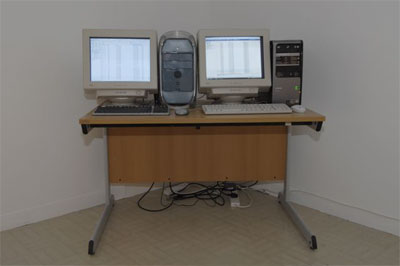
Things aren't always as they appear in automated communication. Cory Arcangel humorously showed us this when he posted instructions for rapidly saving $500 by adding a "Sent by my iPhone" signature to one's GMail account. A similar effect is achieved inPermanent Vacation, wherein two computers enter a logjam of endlessly bouncing auto-replies announcing that each user is away. Viewers watch as the self-generated feedback loop leads to the piling-up of messages in the respective computers' inboxes. The actual message is, in fact, never seen, but a "ding" is heard each time the index of repeated subject lines becomes longer. The work is actually a four-part series that has been showing throughout Europe since last Fall, most recently at Salzburg's Ropac Gallery. Each time it's been exhibited, the computers and their attached monitors or projectors change slightly. Originally, used computers were purchased online and the original owners' names were the names on the inboxes. In the last incarnation, brand new Macs were purchased and placed atop shiny new IKEA tables--perhaps the most convincing "workstation" of the four. Asked whether this evolution in materials was a comment on media change, the master of using defunct hardware replied, "remember, new computers become old computers very very quick, so in the end, they will all look similar." The joy of Permanent Vacation lies partly in its subtle tugging at fears about the "ghost in the machine" or artificial intelligence--the idea that these computers are somehow complicit in this tete-á-tete. Nonetheless, it also implies a kind of human glitch or failure on the part of two subjects to successfully communicate. In science fiction terms, Arcangel has created what might be called a "stasis field"--a space and time characterized by an almost blissful lack of progress. (This would be true of both the computers and the vacay'ing workers.) Ultimately, this time-based sculpture raises the very interesting question of eternity. Could this exchange go on forever? Could a computer's dispatch about an individual's state of being outlive the person's beingness? Or if, in fact, even these computers are doomed to die, where will the messages live? One can only imagine that they will end up on some beach (a.k.a. landfill), once they cease to work, living out their own permanent vacation. - Marisa Olson