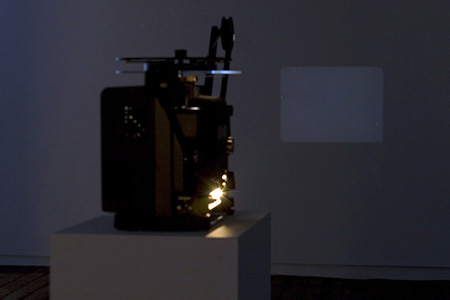
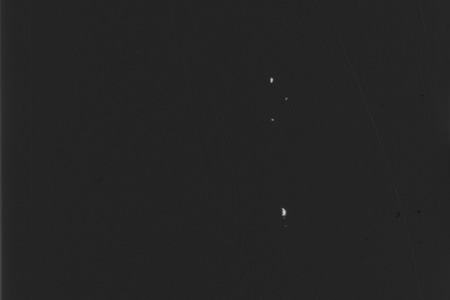
Thomson’s 16mm film, The Varieties Of Experience, was made by using Nam Jun Paik’s Zen For Film (1962-64) as a negative. Zen for Film consists of a length of clear 16mm film leader projecting a rectangle of pure white. Over time, the celluloid collects dust from the space of its exhibition; this dust is projected as brown and black smudges on the otherwise white image. Dust is largely composed of human cells, and in this way the audience of Paik’s work has literally become embedded in it over several decades. Thomson worked with the NJP estate to procure a “dirty” copy of the film and to use it as a negative from which to make a new print. The new film is an inversion of the original: a black film with the dust printed as white specks and clouds -- a moving starscape, where the stars are composed of dust (and people) instead of the other way around.
-- FROM THE DESCRIPTION FOR "The Varieties of Experience" EXHIBITION AT JOHN CONNELLY PRESENTS